


How Long Does It Take To See Results From Working Out
I remember staring at the mirror six weeks into a new lifting program. Nothing. I looked exactly the same. My wife said my shoulders seemed broader. I didn’t believe her. I thought she was being nice.
She wasn’t. I just didn’t understand the timeline my body was actually running on.
Most people quit in the first 4 to 8 weeks. That’s the cruel joke. You stop right before the visible stuff kicks in. The mirror lies to you for about two months. The scale lies too. But your body is changing the whole time. You just need to know what to look for and when.
Here is the real, unvarnished timeline. No motivational speeches. Just biology.

The Short Answer, Straight Up
You can feel different in 2 weeks. You can perform differently in 4 weeks. You will see a difference yourself around 6 to 8 weeks. Other people will notice around 10 to 12 weeks. That’s the honest sequence for most people following a structured plan with decent nutrition.
If you are brand new to exercise, you get a faster clock. If you are coming back after a long layoff, your muscle memory kicks in and speeds things up too. If you are an intermediate lifter trying to add 5 pounds of lean mass, settle in. You are on a 12 to 16 week timeline for visible change.
What “Results” Actually Means
Nobody defines this. That’s why everyone is confused. Results from working out fall into three buckets that happen on completely different clocks:
-
Performance results: You lift heavier. You run farther. You don’t get winded walking up stairs.
-
Internal results: Your resting heart rate drops. Your blood sugar control improves. You sleep deeper.
-
Visual results: Your clothes fit differently. Muscle definition appears. Someone says “have you been working out?”
You can crush the first two categories for two full months and still feel like a fraud in the third. That’s normal. That’s the sequence.
Also Read: Best Foods to Eat After a Workout for Recovery 2026
The 4 Phases of Seeing Workout Results
Phase 1: The Neural Awakening (Weeks 1 to 2)
You don’t grow muscle in your first two weeks. You just get better at using what you already have.
Your nervous system wakes up. Motor unit recruitment improves. The connection between your brain and your muscle fibers gets more efficient. This is why your bench press jumps 10 pounds in week two when you haven’t gained an ounce of tissue. Your brain finally figured out how to talk to your chest.
During this phase, you feel it. Your mood lifts. You stand taller. Your muscles might look slightly fuller but that’s glycogen and water, not new contractile tissue. Enjoy it anyway. It’s a real sign something is happening.
A client of mine once texted me on day 10: “I think I’m imagining it but I feel…stronger? Not bigger. Just more solid.” She wasn’t imagining it. That’s phase one.
Phase 2: Structural Shifts Begin (Weeks 3 to 6)
This is the phase where people panic and quit. The scale does weird things. You might gain 2 to 4 pounds of water weight as your muscles store more glycogen. Your body is building more blood plasma to support the new workload. That’s weight you want. It’s not fat.
Muscle protein synthesis rates elevate consistently now. Satellite cells start fusing to muscle fibers. For beginners, this is the “newbie gains” window. Actual contractile tissue starts accumulating. You won’t see it yet, but a DEXA scan would catch it.
Performance markers get obvious here. You add weight to the bar every session or two. Your walking pace quickens without trying. Your resting heart rate drops 3 to 5 beats per minute.
Phase 3: The Mirror Starts Telling the Truth (Weeks 6 to 12)
Finally. You catch a glimpse after a shower and think wait, is that a tricep?
Subcutaneous fat loss reaches a threshold where muscle definition peeks through. Your posture has changed enough that shirts hang differently. Face and waist changes show up first because those areas respond to the overall metabolic shift faster than limbs.
This is also when someone else finally says something. Research on weight loss perception suggests a change of roughly 8 to 9 pounds on an average-height frame is the threshold where others detect it. That’s typically an 8 to 12 week window with consistent effort.
Phase 4: Body Recomposition Settles In (Month 3 Onward)
The project shifts now. Initial adaptations are complete. Progress slows but deepens.
Your metabolic rate has increased from the added lean mass. Fat oxidation during exercise improves. The paper towel effect kicks in. Each pound of fat lost is more visible than the last. If you stick with it through month four and five, you start to look like someone who exercises regularly. Not just someone who started exercising.
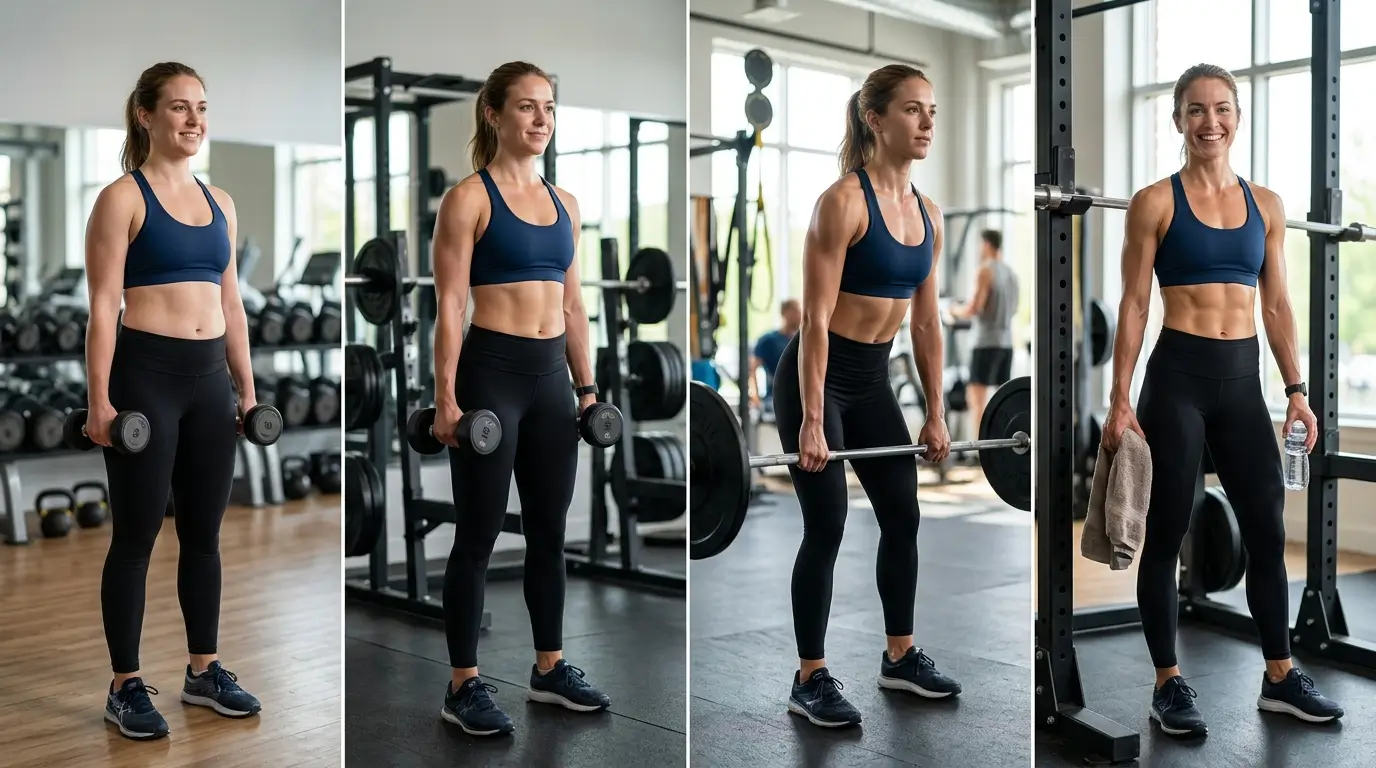
Different Goals, Different Clocks
| Goal | First Sign (You Feel It) | Visible Change (You See It) | Others Notice |
|---|---|---|---|
| Get Stronger | 1 to 2 weeks | 4 weeks (muscle fullness) | 8 weeks |
| Build Visible Muscle | 3 to 4 weeks | 8 weeks | 12 weeks |
| Lose Body Fat | 2 weeks (energy) | 4 to 6 weeks | 8 to 10 weeks |
| Improve Cardio Fitness | 10 to 14 days | 3 to 4 weeks (posture, stamina) | 6 weeks |
Strength is fastest. Your nervous system adapts before your tissues do. Cardio is next because plasma volume expansion happens within two weeks. Fat loss is moderate speed. You can lose 1 to 2 pounds of actual body fat per week safely. Muscle gain is the slowest. A natural lifter might gain 1 to 2 pounds of actual contractile tissue per month on a great program. Anyone promising faster is selling something.
Why You Look Worse Before You Look Better
This happens. It’s not in your head. You start working out and three weeks in you think you look puffier. Softer. Maybe even fatter.
You don’t.
What’s happening is exercise-induced inflammation. Micro-tears in muscle fibers cause fluid retention for repair. Your muscles are also pulling in more glycogen, and glycogen holds water at a ratio of roughly 3 to 1. For every gram of glycogen stored, your body holds about 3 grams of water. This is why the scale jumps up 3 pounds and your jeans feel snug. It peaks around week 3 and fades by week 5 or 6.
Don’t diet harder when this happens. That extends the inflammation window. Eat. Sleep. Wait. It passes.

The Paper Towel Analogy That Changed How I Coach
Take a full roll of paper towels. Rip off one sheet. You cannot see the difference in the roll’s size. It still looks full.
Now take a nearly empty roll. Rip off one sheet. The difference is obvious.
Body fat works the same way. When you carry more body fat, losing 5 pounds is invisible. When you are leaner, losing 5 pounds transforms how you look. The same effort produces wildly different visual outcomes depending on where you start.
A person going from 30% body fat to 25% might not see much. A person going from 18% to 13% looks like a different human. Same 5% drop. Same effort. Completely different visual reward.
This is why comparing your chapter 2 to someone’s chapter 20 is a trap. Their paper towel roll is almost empty. Yours is still full. Keep pulling sheets.
The Adherence Hazard Curve
Nobody talks about this. Every trainer should.
There are three specific drop-off points where people quit. They line up perfectly with the biological phases above.
-
Week 1 to 2: DOMS is brutal. Everything hurts. You feel clumsy and out of place. Quit rate is high if someone didn’t expect this.
-
Week 4 to 5: The initial novelty is gone. The scale hasn’t moved much or moved up. The mirror shows nothing. This is the motivation graveyard. You have to trust the process here with zero visual evidence.
-
Week 8 to 10: Results have arrived but they feel underwhelming relative to the effort. “I did all that for this?” This is where expectation recalibration matters most.
If you know these cliffs are coming, you don’t drive off them. You just keep going. The feeling passes. The results don’t.
What Actually Speeds Results Up
Sleep. This is not a nice-to-have. Muscle protein synthesis peaks during deep sleep. Growth hormone pulses happen primarily during slow-wave sleep. One night of 4 hours of sleep drops testosterone levels measurably and spikes cortisol. You cannot out-train bad sleep. I have watched clients spin their wheels for months because they trained hard and slept poorly. Fix sleep first.
Protein intake. The International Society of Sports Nutrition recommends 1.6 to 2.2 grams per kilogram of body weight daily for people trying to build or retain muscle. For a 180-pound person, that’s 130 to 180 grams. Most people eating “healthy” get half that. Track it for three days. You’ll be shocked.
Progressive overload. You have to do more over time. More weight. More reps. More sets. Shorter rest. If you do the same workout with the same weights for six weeks, your body has no reason to adapt further. Write down what you lift. Add something small next session.
Step count outside the gym. People who hit 8,000 to 10,000 steps daily lose fat noticeably faster than people who crush workouts but sit all day. Non-exercise activity thermogenesis matters more than anyone admits. A morning workout doesn’t cancel 10 hours of sitting.
For the Skinny Guy Trying to Get Bigger
Your timeline is longer than most. Adding 10 pounds of lean mass to a naturally thin frame takes 9 to 18 months of consistent eating and lifting. You have to eat in a caloric surplus. You have to accept some fat gain with the muscle. You will see some upper body fullness around month 3. That’s the first visible win. Keep going. Ectomorphs take longer but the result is striking when it arrives.
For the Woman Over 40 Worried About Hormones
Perimenopause and menopause shift where fat is stored and slow muscle protein synthesis slightly. The clock doesn’t break. It just shifts right by a few weeks. The biggest variable is recovery capacity. You need more recovery than a 25-year-old. Training four days a week instead of six often produces faster visible results because you actually recover between sessions. More isn’t better. Recovered is better.
For the Person Who Just Wants Their Clothes to Fit Again
Fat loss is your lever. A 300 to 500 calorie daily deficit combined with resistance training three to four times per week produces visible waist and hip changes in 4 to 6 weeks. Add walking. Don’t slash calories below 1,500 without medical supervision. That backfires. Cortisol spikes. Water retention masks fat loss. You spin your wheels and blame yourself when it was the approach that failed, not your effort.
Tools That Actually Help Track Progress
The scale is the worst tool for this job. Water, glycogen, food volume, and hormones swing it 2 to 5 pounds daily.
-
Progress photos. Same lighting, same pose, same time of day, once every 2 weeks. The eye adjusts to daily changes. Photos don’t lie.
-
Tape measure. Waist and hip circumference change before scale weight does. Measure every 2 weeks.
-
Performance log. Write down weights, reps, and how the session felt. When the mirror disappoints, the logbook often tells a better story.
-
Resting heart rate. A dropping RHR is an honest signal of improving cardiovascular fitness. Most wearables track this automatically now.
When to Spend Money on Help
A qualified personal trainer costs $40 to $150 per session depending on your market. Online coaching runs $150 to $500 per month. Fitness apps like MacroFactor or RP Diet App cost $10 to $30 monthly.
Is it worth it? If you have never lifted before and you have a specific 12-week goal (wedding, trip, reunion), a coach shortens the learning curve. If you have been spinning your wheels for 6 months with no change, a coach diagnoses what you are missing. If you know what you are doing and just need accountability, an app or a training partner is enough.
Boutique fitness studios like Orangetheory or F45 charge $150 to $200 per month. They deliver results if you show up consistently. The group energy helps some people push harder than they would alone. The workout isn’t magical. The adherence structure is.
Common Mistakes That Reset Your Clock
-
Program hopping. Switching routines every three weeks means you never accumulate enough progressive overload to force adaptation. Pick something and stick with it for 12 weeks minimum.
-
Undereating protein. You break down muscle during training. Without enough amino acids circulating, you rebuild slower. That directly extends your visible results timeline.
-
Ignoring sleep. Covered this already. It matters more than your pre-workout.
-
Comparing your beginning to someone’s ending. Social media shows the final form, not the years of work. Mute accounts that make you feel behind.
FAQs
Can you see results after 2 weeks of working out?
You can feel them. Mood improves. Strength jumps a little from neural adaptation. Muscles might look slightly fuller from glycogen storage. But visible body composition change in 14 days is not realistic.
How long does it take to transform from skinny to muscular?
Noticeable upper body fullness around month 3. A legitimate “that guy lifts” look takes 12 to 18 months of consistent eating and progressive overload for a naturally thin build.
Is working out 5 days a week enough?
More than enough. Five days a week with proper intensity and recovery produces results faster than six or seven poorly recovered days. Frequency matters less than effort and recovery quality.
Why do I look fatter after starting to exercise?
Fluid retention from muscle inflammation and glycogen storage. It peaks around week 3 and resolves by week 5 or 6. Don’t panic. Don’t cut calories aggressively in response.
How long until others notice my weight loss?
Around 8 to 12 weeks, depending on starting point. People typically notice facial changes and posture improvements before they notice body shape changes.
Does muscle soreness mean I had a good workout?
No. DOMS indicates novel stimulus, not effective stimulus. You can have a fantastic muscle-building workout with zero soreness. You can be crippled sore from a workout that did little for hypertrophy. Soreness is not the scoreboard.
How long should a beginner workout to see results?
A beginner following a structured program three to four days per week with attention to protein intake and sleep should see measurable strength and energy improvements within 4 weeks and visible body changes within 8 weeks.
Is it normal to gain weight when you start exercising?
Yes. Water weight from increased blood plasma volume and glycogen storage. This is metabolically beneficial weight. It is not fat gain.
How do I stay motivated when I don’t see physical changes?
Shift your tracking metric. Focus on performance milestones for the first 8 weeks. Adding 5 pounds to your squat or shaving 30 seconds off your mile is real progress the mirror hasn’t caught up to yet. The mirror is the last thing to change, not the first.
If you are six weeks in and frustrated, you are right on schedule. The mirror catches up later. The logbook tells you the truth right now. Keep your phone full of progress photos you don’t look at for two months. Write down what you lift. Eat enough protein. Go to bed earlier.
The results show up. They just take longer than anyone wants them to. That’s not a flaw in your body. That’s how adaptation works. The people who look different a year from now are the ones who didn’t quit at week five when nothing seemed to be happening. Something was happening. It just hadn’t surfaced yet.







Leave a Reply